INNOVATIVE HUMAN RESOURCES STRATEGY -
The overriding theme of this blog is Human Resources from a strategic perspective. This blog looks at current issues facing Human Resources and offers strategic insight needed to create innovative HR leadership for the 21st Century.
I said back in February that I was going to end www.innovativehrstrategy.blogspot.com in May. Well, the time has come to say good bye and to thank each and every one of you for using innovative HR strategy. I hope that the information I have published over the past 5 years has helped you get to the table, understand the need to be innovative and truly be a business person with your CEO and rounded out some of your shortcomings. I know that you will be successful so move forward, take risks that will help the business grow, be the confidant to your CEO, and stay close to the CFO. Good luck and thank you for making this blog a success. Bill Stevens
Good employees are sometimes hard to keep. YouEarnedIt, an Austin, Texas-based employee-engagement app, aims to make it easier for companies toreward and retain employees who matter. The startup raised $1.5 million in a seed round Wednesday.
Launched last October, YouEarnedIt spun out of Rockfish Digital, an incubator. The platform gives companies a creative outlet to virtually shower employees who deserve it with gifts and peer recognition for a job well done, click by click.
What makes YouEarnedIt distinct from, say, Globoforce or Achievers, is that clients can customize the platform to specifically suit individuals at small or large enterprise outfits. This means moving beyond your standard Starbucks gift certificate and offering money, in the employee’s name, to a favored education charity, for example.
Chief executive Autumn Manning said engaging individual employees, or signaling them out for the good they’ve done, is crucial to building company morale. The gift menu bar also contains off-beat congratulations: a haircut from a professional at your home or your lawn mowed.
“Whatever the demographic,” Manning said, referring to her potential client base.
You can smirk at a startup that focuses on virtual employee rewards programs, but YouEarnedIt has 115 paying customers thus far, and it is quickly adding more. Publishing giant Condé Nast is onboard, and so is the Motley Fool. Numerous tech firms have signed up.
Incredibly, it was some of the startup’s clients themselves who ponied up cash for this seed round, which the company will use to help build out infrastructure and hire more engineers and marketing experts, Manning said.
According to YouEarnedIt:
“Through YouEarnedIt, employees are encouraged to engage with their colleagues and recognize the positive in their every day – fostering a happier, more productive work environment through appreciation. Additionally, YouEarnedIt brings a company’s values to life by allowing employees to tag a specific company value when sending the recognition — keeping company values top of mind, socializing them publicly across the organization and reinforcing strengths that employees exhibit.”
We spoke to Manning as she sailed the Caribbean with her husband on a long-overdue vacation, something she hasn’t done in three years. She assured us the seed round was still in Texas.
As for her startup, Manning said that she “saw something was missing.”
“The customers,” she said, “customize the catalog.”
There are many business lessons we take with us every day in the competitive landscape. From an HR prospective how many of you really apply them to your daily work life or even more important to your departments operation? Here are a few from Sun Tzu's " The Art of War" applied into business:
Fight for foreknowledge,
Be invincible, meaning have a superior team of HR professionals,
Attain strategic superiority,
Build a cohesive team, not a bunch of lone wolves,
Coordinate momentum and timing for projects, benefit, and community launches,
Ensure a solid organizational structure,
Be flexible,
Seek knowledge of the business and competitors constantly, and finally
Develop effective internal communications.
So, you really have to ask yourself, do you have these things in place and does your business also have them in place to maintain their competitive edge?
Paycom, a company that pushes cloud-based human-capital management software, will debut on the New York StockExchange tomorrow under the symbol PAYC, for $15 per share. The company announced the news in a press release today.
The figure falls under the $18-to-$20 range analysts were expecting, as IPO investment firm Renaissance Capital noted today. The idea is to offer 6,645,000 shares and pay off outstanding debt.
Paycom competes with plenty of software companies, including Workday, which found success in its 2012 initial public offering.
Barclays Capital and J.P. Morgan Securities are Paycom’s book-runners. Pacific Crest Securities, Canaccord Genuity, and Stifel are the co-managers.
Paycom started in 1998, and as of Dec. 31 it had 840 employees and more than 10,500 customers. It runs its software from data centers in Oklahoma and Texas.
I have thought about this topic for some time and the last seminar I went to really propelled me to write this post. I wanted to update this from my January 2013 post. I am sure each of you have made a bad, questionable or wrong HR hire. I know I have, only twice in my 30+ year career but they were costly to recover. So here are a couple of thoughts when you hire your next staff person and this goes for every level:
as the right questions that answer your HR concerns, issues, and philosophy
make sure their cultural prospective is the same as your company's
don't just replace the person who left, make sure the new hire has band width to grow at a high functioning pace
are they business savvy, not just knowledgeable of business, do they speak business
if they just want to work with people that is a red flag
make sure you spend enough time in the recruiting process and over hire not equal hire
does their philosophy dovetail with yours, so you have to play psychologist/philosopher
make sure they know HR in all aspects not just the position you want to fill
look at operations people/support within your organization, they do real well in HR
pass them through your line managers or the people they will support
I am sure you all know this but it never hurts to bring it to top of mind so you don't get antsy in the hiring process. I would appreciate your comments and any additional areas you think I may have missed. Email me at wgstevens2@gmail.com.
Innovation
challenges "current ways" that are not necessarily "Black
Swans," per se, but rather a normal course of commerce in an instantaneous
information-filled business world. In many respects, determining the priorities
of change and executing to value are a CEO's greatest leadership challenge.
And, for Boards who are charged with the responsibility of evaluating their
company's CEO's progress and performance, it remains their most important duty.
We
asked many of our clients why product and process innovations prove difficult.
It boils down to a leader's balance, and courage.
Knowing
that innovation is disruptive to business models, organizational structure, and
a company's traditional culture (note that Peter Drucker once pointed out that
culture triumphs strategy any day), many CEOs, on balance, believe that change
may be too disruptive, "career risky," and regardless, may not be
achievable during their stewardship. And therefore many CEOs "play it
safe." Yet, as challenging as it is to pivot with the velocity of change
ever accelerating, "playing it safe" or not gaining first advantage
rarely results in maintaining or moving toward a market-leading position.
Courageous
leaders recognize this risk and opportunity cost of inaction. They seek to
innovate and execute, and don't hesitate to reinvent their business proposition
to sustain and/or extend their disruptive advantage. These leaders recognize
that the actions undertaken, i.e. disruptive risk, is all things considered a
superior alternative to becoming a laggard, requiring future triage to catch up
and remain relevant.
Sometimes
tune-ups are mislabeled as innovations, for example improving customer care,
while true innovation requires a significantly different path, of broader
dimensions, to accelerate enterprise opportunity. Be careful to know which is
which, and why.
THE
WINNING HAND IS TALENT
Leading
innovation to tangible value is a difficult undertaking, and a truly
"sensitive matter" fraught with complexities. It requires a clear
vision, commitment, and flexibility. It must be planned carefully, resourced,
and executed with care, taking into account unintended consequences will likely
pop up.
The
most successful CEOs recognize that talent wins out, most especially in times
of significant adjustments. And the CEOs interest (and yes, professional
preservation) in carefully attracting and evaluating the best talent for
his/her inner circle is job one. Talent is their "secret sauce"
necessary to shape and guide the economic future of their enterprise, not just
to react to it.
Without
a team of exceptional leaders guiding and "owning" change,
transformation will fall short.
Forward
thinking CEOs continually evaluate whether they have their best players in the
most impactful roles. They view the recruitment of key executives as an ongoing
responsibility, realizing that they oftentimes don't have the time to develop
internally the special skilled talent that they need now.
THE
BOTTOM LINE
We live
in a world of two truisms: a rapidly reforming world, and CEO accountability to
enhance value, taking into account the opportunities and obstacle, foreseen or
not. And with the realities of short term measurements and "Black
Swans," attracting and investing in exceptional, and oftentimes rare, executive
talent is an investment that pays off. In most cases, the best teams claim the
most wins.
It's
what shareholders expect, and activists demand.
Executive pay continues to make the headlines, which seems to always turn a head.
The Executive Vice President of Human Resources and Diversity at Macy's filed paperwork to sell 46,000 shares of Macy's stock, a market value of $1,399,320 as of July 8, 2011
The CEO of Kendle International, Inc. will be receiving a $2.1 million "golden parachute" following the acquisition by INC., only having just taken the role in the last few months.
The highest paid CEO in 2010 was Philippe Dauman of Viacom, owners of MTV, Nickelodeon, and Paramount Pictures. His pay was $84.5M, just two and a half times higher than 2009.
Are their salaries justified? Some will say yes, but others will complain given the compensation of others within the organization, community, and beyond.
Nonetheless, attracting executives can be extremely challenging when the roles are so critical to the success or failure of an organization. Executive compensation has been examined very carefully in light of the ethical scandals. The Sarbanes-Oxley Act of 2002 has tightened compensation and benefits rules for CEO's and other executives, so companies are exploring ways to attract "the best and the brightest" and still protect shareholder interests and maintain a credible public image.
When it comes to executive compensation, we're finding that companies are focusing less on benchmarking to discover what the compensation level is for other companies' executives and more on aligning compensation decisions with how well CEO's protect shareholder interests over the long term and how well they achieve strategic objectives. Boards are discovering that simply following compensation practices of industry leaders only promotes unnecessary escalation of CEO salaries, with no discernible advantage to the company other than bragging rights about having the highest paid CEO. Shareholders in several companies have actively campaigned to put a cap on CEO salaries and bonuses.
An exception to this practice of curbing salaries simply based on benchmarking is for CEO's who are specifically brought in to turn around a failing company or division. The focus in these cases is still on being a compensation leader.
Some companies are leaning towards stock options as bonuses so that executives "share the pain" with other investors when the company is not profitable. A caveat for companies who are considering this approach is whether this might encourage executives to adopt risky strategies that will pay off short-term, at the expense of longer term sustained progress. Many companies are even starting to require executives to hold stock until they leave the company or retire.
An increasing number of companies are tying executive bonuses to measures of both profitability AND growth. More companies are now evaluating executives on performance and providing additional compensation on the basis of that performance (resulting in both long term and short term success). We recommend a written agreement be established annually about the performance-pay relationship to clarify the metrics that will be used to determine compensation. This will provide a method to track compensation programs over time and assess the correlation to achievement of strategic objectives.
Finding the right total compensation package for your executives is a challenge. There is nothing more disruptive to an organization than the turnover of an executive's role. Don't let the total compensation be the culprit for a key loss, but, balance this with knowing that most executive compensation salaries may eventually be public information.
It is amazing what you learn and hear from people looking for work. Needless to say most are frustrated with the process and the lack of communication they receive from companies. Most notably human resources. I had coffee with two friends the other day who are out of work and have been applying to companies. The main issue they have, and I will say I have heard this for years and years, is they do not hear back from companies when applying through the company website or HR. No response, not even that they receive their resumes. The other main gripe is that the process takes forever. I am sure the companies are looking for the exact right person who checks off each and every box needed. I can tell you from experience that if you are looking for an exact look-a-like then you are not diversifying your human capital experience. So what is the take-a-way from this HR? (1) make sure your website or third party recruiting process has an auto response, not only for the initial response but a follow-up after so many days to let the candidate know they are still in the running. (2) diversify when looking for candidates and I don't just mean from a EEO prospective but from a job experience prospective as well. (3) speed up the process. (4) Communicate, communicate, communicate much like in real estate location, location, location. All of the issues these two prospective candidates have makes HR look bad and that is not good for them or the company. Remember, for the most part you are the face of the company. If you can't do these simple things then I would tell all candidates to go around HR and direct to the hiring managers.
I thought this was important enough to re-post this for all in HR I was on vacation in Europe for 2 weeks and had a lot of time to think, design, evaluate, and reset my HR thought process. During that time here is what I came up with, and guess what so did the HR Executive. HR has been denigrated, criticized, scoffed at, laughed at, bureaucratically maligned organization since the 1950's. My guess is that if the current practitioners do not see the writing on the wall they will at some point be out of a job and scratching their heads asking why. Well, let me tell you now that I have an outside view looking into organizations. The have the following key flaws:
they take time away from business from line managers and employees
they still do not understand the business from the inside but try to use business speak as their entry into it
there is really not a clear mission for the group and how it ties to the business
expectations are impossible to say the least
people really do not know what HR people do
the systems and programs that they establish or use are counter to business productivity
people in general do not trust HR people (you know that drill - when they see an Hr person milling around all they can think of is bad news is coming)
employees do not think HR is objective - only a management speaker
what managers and supervisors don't want to handle they send to HR - sound familiar?
I can go on and on but those are some of the salient points I wanted to make. So as I was sailing in the Mediterranean this all came into real focus and I had that "a ha moment". Blow it up and start over in 2012 terms not what has been built up over the last 50+ years and multiple retooling that really did not fix the core problem.
So I will reiterate what Jac Fitz-Enz said in the September issue of HR Executive. Solution, break up HR and restart with four distinct groups:
Governance - this should fall under the CLO
Record Keeping ( Administration) - this should fall under the CFO
Employee Relations - this should fall under the COO or Operations
Strategic Development - this should report to the CEO
From there you that the specialty functions and fit them where they best belong ( comp under the CFO, staffing under the COO etc). In today's real world business environment I feel this is what we should do with HR. I know a lot of you will not agree with this approach since it puts your job in jeopardy but if you really think about it this is a 21st century strategic approach and that is what this blog is all about.
Glide is a new iOS app from the company of the same name. It’s available now as a free download from the App Store, with no additional in-app purchases.
Glide positions itself as “the Voxer of video” — in other words, it aims to offer push-to-talk functionality combined with the ability to broadcast live video and record video messages to be reviewed at a later date. Early impressions of the app seem to indicate that it does an excellent job at both of these tasks, with a few caveats.
At present, Glide requires a Facebook account to log in. The company says that in the near future sign-in will be possible with other services, but for now it is limited to Facebook. This is not an unreasonable requirement for a social app, but in certain territories — notably the U.K. — App Store reviewers have historically been rather resistant and critical towards apps which have Facebook as their sole option for creating an account and/or signing in.
Once into the app proper, Glide has a pleasingly simple interface that follows a lot of the popular conventions of the moment. A pop-out drawer on the left of the screen allows access to information about the app, links to the developers’ social media presences and the ability to contact them directly for support. Another pop-out drawer on the right allows access to the user’s friends list as well as the facility to create new groups and invite friends from Facebook to start using the app. The friends list indicates whether the users are online and whether they are currently broadcasting, watching a video message or typing.
On the app’s main screen, message threads are organized chronologically with relative timestamps. Tapping on a message thread reveals it. Individual messages may then be played back, and the user may “broadcast” to the group at any time by tapping the camera button at the bottom of the screen. If group members are online at the same time, they may watch the user’s broadcast live; if not, it is recorded in the thread for later playback. All videos are stored online and streamed to group members’ devices, so an active Internet connection is required to play back messages. Tapping a button in the upper-right corner of the screen allows the user to add additional friends to a conversation and also to switch between the device’s front and rear cameras as desired. Meanwhile, a “T” button in the lower-left corner of the screen allows for quick text responses to messages that do not really warrant a full video message. The user is notified of these new text messages immediately via a popup message, even while watching other videos.
Glide is an extremely simple app, but this simplicity allows it to concentrate on doing one thing really well. It’s a good solution for sending quick and simple video messages back and forth between two or more people and provides a well-implemented, thoroughly modern means of communication. The only real issues with the app at this present time are the fact it only supports Facebook logins — a fact which is apparently being worked on — and the requirement for an Internet connection to view past video messages. The app positions the fact that all videos are stored “in the cloud” as a selling point, but it would perhaps benefit from the option to cache videos or save specific messages that the user would like to keep handy at all times, even when they do not have a reliable data connection.
I overheard an exchange between a mother and young child at a store the other day. The child was trying to communicate with the mom and the mom said, “The best way to help is be a good listener.” The child began to talk and the mom quickly and ferociously cut her off and said in a sharp, condescending voice, “Oh, you’re already not being a good listener! The best way to help is to be a good listener.” This went back and forth for several minutes with both the mom and the daughter becoming louder and more firm in their response. Finally, the daughter gave up. You know what? No one won.
That’s right. In her zeal to teach her child that the best way to help is by being a good listener, she completely missed the fact that she was NOT LISTENING. Now, I’m not the perfect mom all the time, just about 50% of the time. Seriously, I know that little ones can try your patience. But the point is that we spend so much time trying to teach someone else what is “right” that we don’t do it ourselves. It’s no different in the workplace.
How many times do we see managers telling an employee the same thing over and over only to have the employee do something completely different? How many employees have to come to HR to complain that their manager never listens to them? Then, HR has to try to give recommendations on how to bridge the gap in that conversation. I’d say it’s almost a daily routine. What we need to do is tell managers to start talking less and listen more.
If an employee is not doing something “right”, instead of telling him that the manager could say, ”Hey, I see how you’re doing XYZ. Tell me how that is working for you.”- This allows the employee a chance to say why they do something a certain way, aka have their voice heard. Then, the manager can follow up with something like, “That seems like a good reason. Have you ever thought of doing XYZ to enhance that?” Now you’re in a dialogue and the employee is far more likely to embrace the suggestion.
By taking time to really listen to an employee you will achieve better results in terms of:
Engagement- Employees who have their voice heard and then see those ideas validated will have higher levels of engagement with you and the department.
Teaching and Coaching- When you listen to the employee, you have a greater chance that you can teach them why something is important to handle in a certain way. They will be more accepting of process changes, procedure changes, or other change happening in the department. This is also the way to give them opportunity to voice their concerns and you the opportunity to coach them through it.
Learning- Even the highest level executives are continuous learners. By taking that extra time to listen to an employee, you will definitely learn something. It will spark new ideas, new ways to communicate, help you develop your own skill as a leader, and more.
So, the next time you are coaching your leaders, make sure they understand that by pausing to listen to the employees, they will reap the rewards. What other techniques do you use to convince leaders that listening is one of the most valuable tools they have? Share it in the comments.
Learning to be funny can enhance your communication skill. Most people love a good humorous story. A speaker is always easier to listen to if they can make you chuckle at their story. Unfortunately many people do not have this skill. They attempt to be humorous by telling jokes and end up being humorless. If you want to improve your communication skill learn to be funny, learn to weave humorous stories into your training, your speaking, or your conversations.A growing trend
According to The Herman Trend report, more and more “C-Level executives are embracing the value of going beyond the occasional humorous remark and learning stand-up comedy.” The have learned the teaching and connecting value of making people laugh. I use humor in my presentations, usually by relating something humorous that has occurred in my HR career. After all if something funny or ridiculous has not happened to you in HR then I would be surprised. The ability to relate it to others is where the skill comes in.
Take a class on doing “Stand-up”
I have taken a class on how to do stand-up comedy. I have no aspirations of ever being a professional comedian, but I did learn a lot from that class. I learned that it takes practice to look poised. I learned how to think on my feet in front of an audience. I learned how to handle a heckler (the role played by the instructor). I learned the value of using humor to bond with your audience. A common theme in my class feedback is the attendees have enjoyed my stories and my sense of humor.
Here in the Atlanta area there is a comedian, Jeff Justice, who does corporate training and teaches business people on how to use comedy to accomplish their business goals. I know a number of his graduates and have seen some of them in action. It works. I can recall one individual in particular who was as stiff as a board in his normal presentations. Jeff helped him parlay that stiffness into a humor style that worked for him. Jeff bills himself as the Humor Resources Director, and that title endeared me to him. By the way, I have no relationship with Jeff other than admiration for his work, so this is not a paid commercial.
The value
According to Judy Clark, who was mentioned in The Herman Trend Report, there are five takeaways to learning to be humorous:
Participants learn how to practice light-hearted self-mocking. When we find out what people are saying about us and make light of our own foibles, we take back our power.
Learning how to handle hecklers as stand-up comics, translates into valuable communications skills; they know how to handle difficult people with grace.
Writing jokes together is a creative and bonding experience. “Nobody writes comedy alone,” states Carter; we all need others to help us determine what’s really funny.
People learn it’s OK to take risks—to do things that scare them.
Finally, participants learn how to effectively communicate difficult issues in a way that people will hear it.
So if you want to be a better communicator you may want to think about taking a class on stand-up comedy. You may discover something about yourself.
Many companies have tried to come up with a single service that allows teams to work effectively without email, but former Flickr founder Stewart Butterfield believes he has done it with Slack, which integrates with dozens of different data sources including Twitter
When Flickr co-founder Stewart Butterfield was building an online game several years ago, he and his team of designers and developers built their own hacked-together IRC-based replacement for instant messaging and email as a way of getting things done. After he shut the game down last year and was looking for something else to do, Butterfield decided his workflow software was worth refining, and the result is Slack, which launched to the public today.
If there’s one market that is filled to the brim with competitors — even more so than consumer photo-sharing apps — it has to be workflow or collaboration services. There are large, project-management style suites like Basecamp (which 37signals announced it is now focusing on full time), as well as HipChat, Microsoft-owned Yammer and Salesforce’s Chatter, along with half a dozen others like Asana.
On top of that, many companies and teams use a variety of other services to accomplish the same thing, whether it’s Skype or Google Hangouts. So what makes Butterfield think that he can beat all of these competing solutions? He says no one is approaching the problem in the same way that Slack is — namely, by integrating as many different information providers and pipelines as possible.
“There are three basic types of message: One is a person writing to another person, another is someone trying to send a file, and the third is computers sending you a message — like you have a new follower on Twitter or someone commented on your post. We figured if we could get all three of those kinds of message in one place, there was a chance to build something that would be the one app you have open all the time.”
One ring to rule them all
Butterfield says the need for something like Slack is shown by how quickly adoption has grown: the service launched as a beta “preview” last August, and did no marketing or media relations of any kind, but has continued to grow at double-digit rates week after week for six months. One of the company’s venture backers, Marc Andreessen of Andreessen Horowitz, said: “Growth like this is not something we have seen before. Enterprise software growing 50-80% per month based entirely on word of mouth is unprecedented.”
Butterfield says he didn’t want to build a project-management tool like Basecamp because that inevitably involves philosophical issues about how projects should be managed — instead, he just wanted to put together a single communications tool that would pull in as many different sources of potentially useful information as possible for teams, whether it was chat or automated crash reports.
Slack, which has both an iOS app and an Android app as well as a Mac app, allows team members to easily track messages from co-workers but also to see status reports from across the company, by connecting to tools like SVN, Github, MailChimp, Crashlytics, Heroku and JIRA — things that would otherwise have likely remained in a separate silo or service. An API allows for almost any other service or tool to be integrated into the system as well, Butterfield said.
“We see a lot of people switching from Hipchat or Campfire, but we see an even larger number — an order of magnitude more — coming from nothing. Either it’s a jumble of different services or just email or just Skype, or maybe this group has IRC, this other one uses Hangouts — it’s like a hodgepodge. There is no one service where all the communication goes.”
Ambient awareness of your colleagues
The problem that arises when teams within a company don’t use the same tool, Butterfield says, is that information becomes hard to find, since there is no single repository of all the important data. Teams using Slack “get this kind of ambient awareness of what people are doing. So, for example, the engineers can see what people are tweeting about us, so when we say they’re complaining about this or that they actually take you seriously.”
Butterfield says Slack’s adoption curve is growing faster than Flickr did at any time during its history pre-Yahoo, and is also growing faster than many other workflow-related startups such as Github. The Slack founder said he doesn’t track things like installs or signups because those metrics are “bogus,” but the app is now being used by a wide range of companies from startups like BuzzFeed and Square to large companies like Citrix and Expedia.
True real-time workplace collaboration is something of a holy grail, Butterfield says, in the sense that companies keep promising it will arrive but it never really does — and so teams continue to use email even though it is broken, or mash together various pieces of software to try and make something that works. “There’s a 30-year legacy of broken promises around collaboration, from Lotus Notes on,” he says. “But I feel like now the world is ready for it.”
I had a great discussion with one of my close friends here in Atlanta who is an accomplished executive recruiter and owner of an elite boutique placement firm. We discussed relevance in today's market and how much impact you have if you are not relevant. Well. you have to guess this really got me thinking about my HR blog and me as well. I have been thinking for some time to shut down my blog in May which will be it's 6 year anniversary. Why you ask, well for the reason my friend and I discussed, relevance. I have had the luxury to mentor, guide, and educate people on HR matters, policy, and how to get to the table where HR belongs. I have also been very outspoken about being innovative and creative in the role as well as not just being a business partner but a business person who can run the business. My blog has received 3 years running, 2011, 2012, and 2013 "Best Blog" from the Human Capital Institute. It has been associated with Meet the Boss TV, and written about in Human Resource Executive magazine. I think I have reached the goals I set back in 2007 when I was thinking of doing a blog. That being said, after leaving my former company in 2007, I have consulted with small start-ups, large corporations, done due diligence as a sub-contractor but have not been directly involved with a business full time since that time. I think I have imparted lots of relevant knowledge through my blog but as the dynamics of HR and business change I really am not in the forefront anymore; on the outside looking in so to speak. For those reasons, I will shut my blog down in May 2014 and hope that it has provided you with valuable information and insight into the role HR should play in business today. I will continue to post relevant information until May and hope that you will continue to read my blog until then and refer to it thereafter. Thank you for reading InnovativeHRstrategy and I wish you all the great success you deserve in HR.
There is a great article in Fortune magazine this month (February 3, 2014, go to Fortune.com) about hiring top talent. The most interesting thing about the article is not the hiring of top talent which has been a mantra for HR for many years but how they are hired. The article indicates that most HR executives have been blindsided by people looking for jobs using their mobile devices and not the traditional new wave of using the website. 82% of the 1,000 job seekers surveyed by Glassdoor.com said they expected to use their mobile devices during idle time to look for jobs. HR get readjusted and make sure you are not on the long end of this trend. Candidates want things on the palm of their hand, not a laptop or desktop anymore.
A cluttered hard drive can be disorderly and slow, but it can also be a security hazard. This is especially true of any software on your PC that you rarely, if ever, use. Perhaps you installed a free demo, or you completed a game and you’ll never touch it again.
Chances are good that the software you’re not actively using isn’t being patched and kept up-to-date, which means it may leave your PC vulnerable to exploits.
Just as you regularly remove expired jars of mayonnaise and uneaten leftovers from your refrigerator (right?), any time is a good time to rid your PC of useless and unwanted programs. It never hurts to clear out old data files you’ll never need again, too. Here are some tips to help you purge all that dreck from your PC.
Unused applications
In Windows, go into the Control Panel, look under Programs, and click Uninstall a program. A window will display a list of all the applications installed on the PC. By default the list is organized alphabetically, but you can click the Publisher, Installed On, Size, orVersion column heading to sort the list accordingly.
If your goal is to free up space on your PC, you should start by sorting the list of applications by size. You’ll be able to quickly identify which software is taking up the most space on your hard drive, and remove the applications you don’t need or use.
Windows has its own tool for uninstalling applications.
The built-in Windows tool isn’t always the best, though, and sometimes the uninstallation process leaves trace elements of applications behind. For a more thorough housecleaning, look to a utility such as Revo Uninstaller.
Revo can scan your system for remnants left over from the standard uninstall—orphaned Windows services, file associations, shell extensions, and other components—and forcibly remove them. A free version of the software is available, but you need the $40 Revo Uninstaller Pro to get the greatest benefits.
Revo eliminates orphaned items or stray bits of programs that the Windows uninstaller might have missed.
Unnecessary services
Windows services are also programs, but not the kind that you actively use. They run in the background, mostly starting and stopping automatically. They perform many core system functions and assist software applications in interacting with the Windows operating system in various ways.
Identifying what each service is, or what it does, and whether it’s really necessary can be both confusing and challenging. Removing a service that your system actually needs can have negative consequences on your PC and the applications you use, so you should tread with caution.
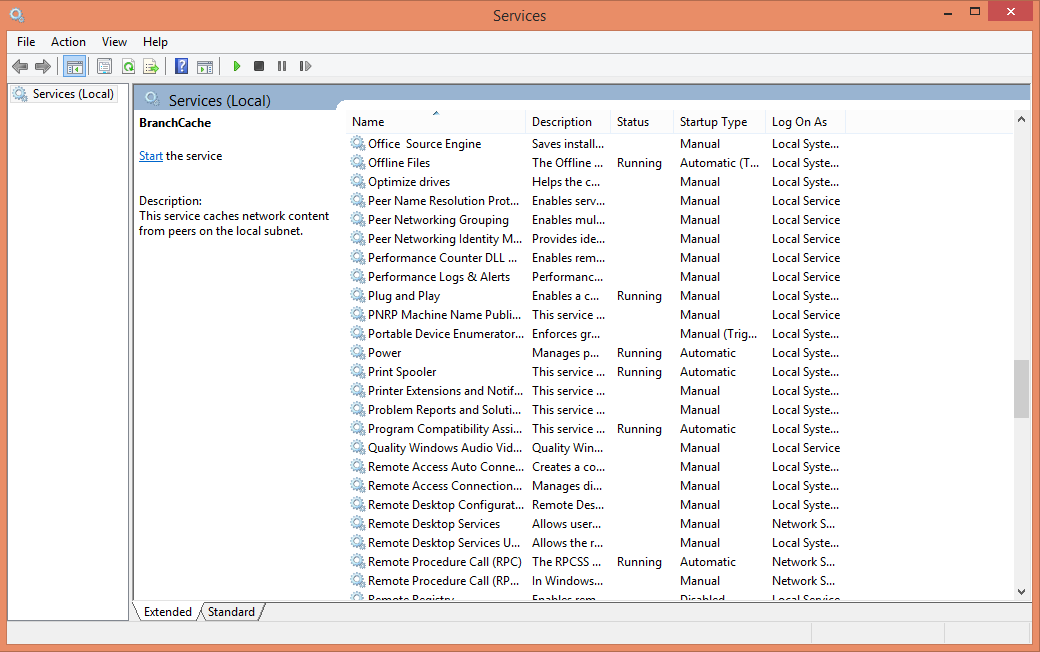
You can see all Windows services and their current states by opening the charm bar, or clicking the Start button, and entering services.msc in the search field. Similar to the program-uninstallation console, the Services panel displays all of the services alphabetically by default. You can also sort the listing by clicking the Description, Status,Startup Type, or Log On As column.
You might not need some Windows services, but proceed with caution lest you remove something your PC is actually using.
Five services in particular are rarely used by most people and could expose your PC to unnecessary risk. If you don’t connect any Bluetooth devices to your PC, you have no reason to keep the Bluetooth Support Service enabled. If you don’t use Remote Desktop, you should disable the three Remote Desktop services. The services listing also includes the Remote Registry service; this item is typically disabled by default, but you should make sure it’s not enabled.
If you want a longer list of potential services to axe, check out this post on the Internet Security Blog. Remember, though, don’t be overzealous about disabling services you’re not sure about, and be prepared to turn a service back on if your PC starts having problems.
To change a service, right-click it and choose Properties. In the middle of the General tab is a field called ‘Startup type’. Change this setting from Automatic or Manual to Disabled. Just below that is a section called ‘Service Status’. Make sure the current status isStopped. If it isn’t, click Stop. Finally, click OK at the bottom to save the changes you’ve made.
Obsolete data
Most people are guilty of hoarding data to some extent—much of it, perhaps, without their knowledge. You might have duplicate copies of music or photos, or Word documents for reports you wrote seven years ago, along with temporary and cached files that might be hogging gigabytes of space on your hard drive.
Hard drives are relatively cheap, and it’s not uncommon for PCs on the market today to come with a terabyte or more of storage, so having lots of data files sitting around may not seem like a big deal. A PC relies on unused storage as an extension of RAM, though, and as your drive runs out of space—or as the available space becomes scattered and cluttered—it affects performance.
Windows has its own utility to neaten up a hard drive whose data has scattered hither and yon and is slowing performance.
Windows offers built-in utilities that can help. Right-click the drive you want to work with in Windows Explorer, and select Properties. On the General tab, you’ll see a Disk Cleanupbutton; click this button to have Windows scan the drive and identify the redundant or unnecessary files it believes you can safely delete. You can check or uncheck the different boxes, and click OK to clean up your drive. Clicking the Clean Up System Filesbutton performs a more comprehensive analysis of Windows system data you can sweep away.
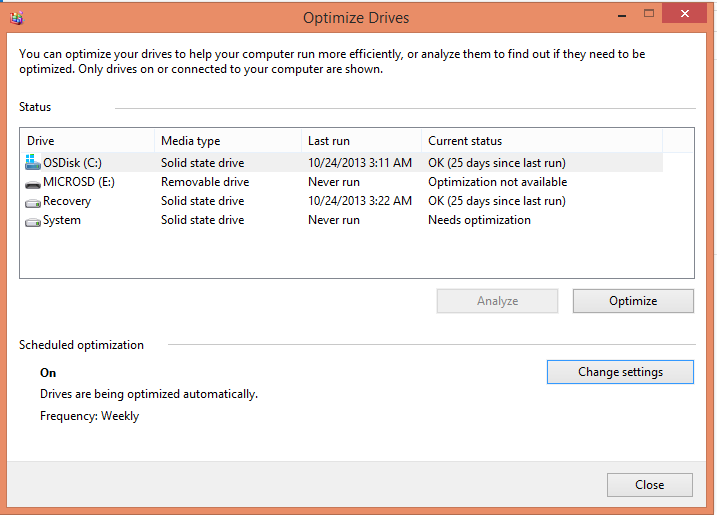
Click the Tools tab of Drive Properties to see an option to defragment and optimize the drive. Over time, the files on your drive become scattered about as Windows reads and writes data to different portions of the drive. Defragmenting the data helps Windows operate more efficiently, and reduces wear and tear on the moving components of traditional drives.
In Windows 8, the button says Optimize. When you click it, the current disk-optimization settings for each of your drives are displayed, along with the current status specifying the last time the drive was optimized. You can click the Change Settings button to choose which drives should be optimized automatically, and configure the frequency of scheduled optimization to Daily, Weekly, or Monthly. I prefer Weekly as a reasonable middle ground.
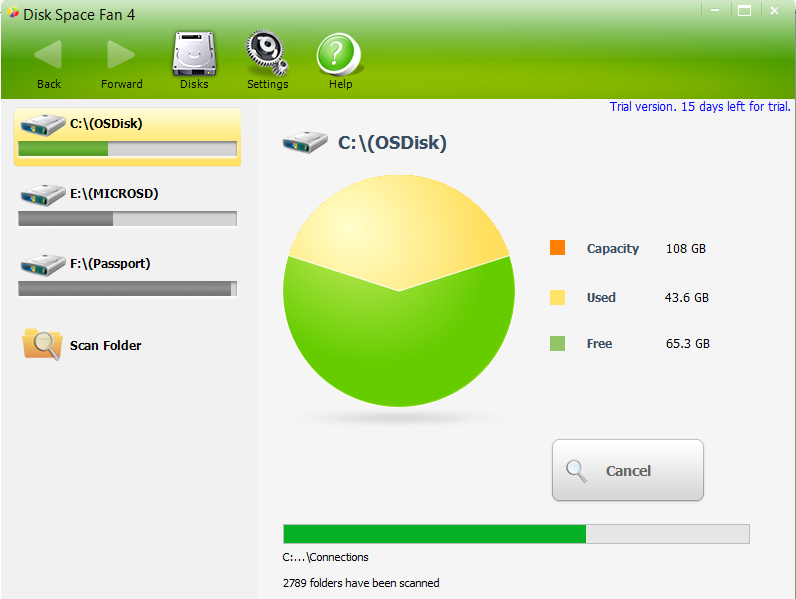
Disk Space Fan helps ferret out additional files that you could delete.
For a more aggressive approach, you can try a third-party tool such as Disk Space Fan. Even after you use the Windows Disk Cleanup tool, Disk Space Fan can find additional files that you probably don’t need on your system. Disk Space Fan also identifies duplicate files and provides a simple way to remove redundant data.
Whether you have 100MB or 3TB of storage capacity, there’s no point in filling it up with applications and data you don’t need, and possibly exposing your system to unnecessary risk of compromise or exploit. Spend a little while to clean up your PC every now and then, and you’ll optimize its performance and keep it safe at the same time.
.jpg)