Sunday, February 10, 2013

Two Tips to Being a Better Listener


Listening, really listening is probably the weakest skill for many managers. HR managers are no exception. Quite often while listening we are already formulating what our response is going to be and thus we do not hear the rest of what is said. Here are two tips that will make you a better listener.
Listening is as important as speaking
Seth Godin, in his post entitled How to Listen, basically says that the listener has as heavy an obligation in an interaction as does the speaker. After all, no idea is communicated if the person being spoken to is not listening. Listening is hard work and needs to be practiced. So here are two things that will make you a better listener.
Be an active listener
Show people you are actually listening. As Seth Godin says “Pay back the person who’s speaking with enthusiasm.” This means your expression, your questions, your nodding, and your posture. We all know how irritating it is to talk to someone, or try to talk to someone, who is not looking at you and not responding to what you are saying. Spouses experience this all the time. But so do employees talking to their managers.
Play back what you hear
One of the best ways to confirm to someone that you listened to them is to feedback to them what you heard. It does not need to be a “tape recording” of what they said; it can be your version. In fact it should be your version so that you can demonstrate that you actually understood them. Godin says “Don’t ask questions as much as make statements, building on what you just heard but making it your own. Take what you heard and make it the foundation for what you are trying on as your next idea.”
Bonus tip
If you disagree with what the person is saying don’t jump in to immediately shoot the idea down. Wait until they are done speaking and think for a moment on EVERYTHING they said. If after that you still disagree then explain why. Focus on the idea and not the person.
Godin had a great closing remark that I think all managers should apply to their dealings with their employees. He said “The best way to honor someone who has said something smart and useful is to say something back that is smart and useful. The other way to honor them is to go do something with what you learned.” This promotes the useful interchange and exchange of ideas. Your employees, and for that matter your spouses, children and friends, will be much more likely to talk you and feel valued as a result.
by Michael Haberman of OmegaGRsolutions.com 

Sunday, February 3, 2013

Social Media Etiquette: 12 Step Checklist


I love social media. I can connect with others and quickly find out what they're doing. But when I learned some people are now finding out about the death of friends via Facebook, I began to despise the impersonal nature of these online social tools.

The truth is, there’s simply a lack of etiquette many people possess when using social media. I recently had a discussion with Lisa Filpi Goeckler, who has a new social media endeavor with ON Food, a startup in Beverly Hills that partners with fitness professionals and real people offering all-in-one food solutions. Lisa shared a few stories with me, the first occurring a few months ago when she found out about her good friend and co-worker’s death on Facebook.

After seeing a mournful Facebook update from a friend, Goeckler was able to use Facebook to confirm her friend had died of a major heart attack. “I was not keen on the way I found out about the death,” she said. “It seemed so impersonal.”

A few months later, Goeckler found out–also through social media–that a relative of hers had breast cancer. Finding this out via social media–not a phone call–was a disconnected and impersonal way to find out such serious news, she says.

These stories made me reconsider how we use social media. These two incidences were huge life events that may not have been properly handled by being blasted through Facebook posts.

Social media is valuable, but we should teach etiquette to guide people on the best ways to use it. Goeckler says everyone should ask themselves the following 12 questions before posting:
  1. Should I target a specific audience with this message?
  2. Will anyone really care about this content besides me?
  3. Will I offend anyone with this content? If so, who? Does it matter?
  4. Is this appropriate for a social portal, or would it best be communicated another way?
  5. How many times have I already posted something today? (More than three can be excessive.)
  6. Did I spell check?
  7. Will I be okay with absolutely anyone seeing this?
  8. Is this post too vague? Will everyone understand what I’m saying?
  9. Am I using this as an emotional dumping ground? If so, why? Is a different outlet better for these purposes?
  10. Am I using too many abbreviations in this post and starting to sound like a teenager?
  11. Is this reactive communication or is it well thought-out?
  12. Is this really something I want to share, or is it just me venting?
Consider these questions before clicking “post.” You’ll be happy you double-checked before making a slip-up public to the world.
(Image courtesy fredcavazza, Flickr)
Ilya Pozin is a serial entrepreneur who founded Ciplex, a web marketing and creative agency, at age 17. Ciplex has been recognized with an Inc. 500|5000 for two consecutive years.

Saturday, February 2, 2013

Breaking Myths on Entrepreneurship

If you are interested in myths about being an entrepreneur then you should click on this link.

http://www.slideshare.net/prateekshah03/breaking-10-myths-about-entrepreneurship

Thursday, January 31, 2013

What Is Innovative Human Resources (HR)

I actually believe that innovative HR is quite simple. I have said this since I first got into HR in the 1970's. Innovative HR takes tactical and strategic practices and adapts them to integrate with a company’s business strategy and culture. 

The most powerful HR innovation comes from working with business leaders to develop the “next practices, product, business application” that gives a company a competitive advantage and ability to thrive in the new world of business. HR should be the new 'business disruptor's". HR’s role is to adapt HR strategies and practices to help the company succeed in the future, not tie it down with systems. HR innovation comes from working with business leaders to create practices that give the company a competitive advantage in the marketplace.

Do you think this way and if you do then you are going to help your business thrive in the new world order. 

Wednesday, January 30, 2013

HR's Big Challenge for 2013: How Do We Help Our Organizations Succeed?


What did you learn today?

“Morning Joe,” which is a show that I watch on MSNBC, always asks the most profound questions at the end of every show. Each guest talks about their learning moment for the show.
During the hiatus from work last week, I heard the question asked and thought about it in the context of what I do as a consultant, blogger, and social media enthusiast.

Given that it was the end of one year and the beginning of a new one, I looked back and thought about 2012 and what I learned.

What did you learn?

HR has been headed into an unrelenting storm. Transforming HR has been the focus for the past few years. It makes you wonder: where are we headed and when will we get there? Then again, maybe you are already there. I do know that there is no one size that fits all. Best practices, while good to be aware of, are not the silver bullet.

HR is in an enviable position at this point. Our work is being discussed in the board room; our work is being discussed by the CEO (CEO Insomnia Index).

As David Ulrich said in his book, HR Transformation: Building Human Resources From the Outside In,“Simply stated, we propose that the biggest challenge for HR professionals today is to help their respective organizations succeed.”

That, to me, is our overriding mission and that is my learning point for 2012. How do we help our organization succeed? That is the big question in all of our lives — or it should be.
We have better buckle up because the runway is clear. There are no planes ahead of us. We are positioned to take off. We have to become students of our own profession.

The organizational environment has become far more complex than ever before, both the internal complexity as well as external forces of Hurricane Sandy magnitude. This complexity has been driven by huge technological changes, layoffs, industry disruptions, economic turmoil, and more. In every walk of our professional lives, change is at the forefront.

These changes have in turn been an equal opportunity affecter. Whether in your industry, your organization or individually, change has permeated our environment. The world in which we all operate has become extremely complicated.

Do you understand the position you are in?

What are the main issues facing your organization? That should be at the top of your 2013 to-do list. HR must know what it takes to get your organization back on track, or to stay on track for that matter.
How can HR make sure that alignment between the organization, its employees, and other stakeholder groups stays aligned? As Dave Ulrich said, “How can we help your organizations succeed?”
Today, organizations are more complex than they were 10 or 20 years ago. The factors that I see that are:

  • The economic environment (which includes the organization’s financial situation as well as the competitive and general economic environment).
  • The technological environment has disrupted our entire society. How do we play in the new environment?
  • The social/cultural environment.
  • The sustainability environment (what is your organizations strategy and how does that align with your people?).
  • The regulatory and legislative environment. New taxes, new health care laws will be felt for years to come.
This is the whirlwind that has engulfed your environment. The unrelenting pressure shows no sign of letting up. But then this is not be a pity party for HR because Marketing and IT and other departments are all both trying to navigate this within their organizations.

So as we analyze what we have learned and use those as anchor points to move forward, we must remember what I think are the four most important words in our lexicon: Read, discuss, analyze, and formulate.

a reprint from StrategyfocusedHR @ www.strategyfocusedhr.blogspot.com 

Tuesday, January 29, 2013

Stanford's Jeffrey Pfeffer Criticizes Companies For Killing Their Employees - Leadership


Two days ago, Jeffrey Pfeffer, Stanford Professor of Organizational Behavior, wrote this on Bloomberg Businessweek:
“It would be nice in 2013 to have human values and well-being play more of a role in decisions about business practices, including the choice of suppliers and how far companies will go in their decisions and management practices to save or make money. There must be some limits, some sanctions, some consequences for bad behavior—even if it is profitable behavior.”
He cites the ethical lapses at banks, such as HSBC (money laundering) and Bank of America(mortgage abuses), before focusing on a different imperative: access to healthcare.
“Companies that lay people off affect those individuals’ lifespans and their likelihood of suffering ill health: suicide, depression, and unhealthy behavior such as smoking and alcohol abuse have been linked to job loss and economic insecurity,” he claims.
Like Pfeffer, I want to protect individuals from organizational abuse. I’m troubled by karoshi, the Japanese phenomenon in which men are dying from overwork. But how much responsibility should an organization accept for an individual’s actions?
CEOs have to manage their psychological state, too. I’m reminded of how distraught former JetBlue CEO David Neeleman was when a mechanical malfunction forced Flight 292 to perform an emergency landing in 2005.
Pfeffer recommends that companies factor people, as well as financial, implications into their management decisions.
It starts with emotionally intelligent leaders, not a rigorous decision-making process. After Loudcloud escaped bankruptcy, CEO and co-founder Ben Horowitz restructured, laying off a third of the employees, transferring a third to new investor EDS, and keeping a third in a new company, OpsWare. He consoled those who weren’t so lucky, even helping them carry their belongings to their cars.
In February 2009, the casino industry was struggling, and Steve Wynnreduced the pay for all the employees at his two Las Vegas properties. He didn’t want anyone on unemployment or out of insurance.
In both examples, the leader considered the impact of his decision on the livelihood of his people.
Many blame business schools for failing to instill ethics into their graduates. While they’re partially responsible, the truth is that most CEOs aren’t MBAs.
Follow Drew on Twitter @drewhansen26
Drew Hansen, Contributor
I write about innovation, entrepreneurship, and leadership

Monday, January 28, 2013

Managing Yourself: Bringing Out the Best in Your People


Some leaders drain all the intelligence and capability out of their teams. Because they need to be the smartest, most capable person in the room, these managers often shut down the smarts of others, ultimately stifling the flow of ideas. You know these people, because you’ve worked for and with them.
Consider the senior vice president of marketing who, week after week, suggests new targets and campaigns for your team—forcing you to scurry to keep up with her thinking rather than think for yourself and contribute your own ideas. Or, the vice president of product development who, despite having more than 4,000 top-notch software engineers on staff, admits that he listens to only a couple of people at development meetings, claiming “no one else really has anything much to offer.” These leaders—we call them “diminishers”—underutilize people and leave creativity and talent on the table.
At the other extreme are leaders who, as capable as they are, care less about flaunting their own IQs and more about fostering a culture of intelligence in their organizations. Under the leadership of these “multipliers,” employees don’t just feel smarter, they become smarter. One example is K.R. Sridhar, a renowned scientist and the CEO of Bloom Energy, a green-tech firm. Sridhar recruits elite talent but is careful not to cultivate prima donnas, who might dominate the team’s thinking. When one of his star scientists began relentlessly pushing his own ideas, even handing Sridhar an ultimatum, the CEO chose to place his bets on the team, even though his decision might jeopardize the next product launch. After the loss of this seemingly critical player, the rest of the team rallied, quickly learned new technologies, and successfully hit the release date.
Although working for multipliers like Sridhar feels great, these leaders aren’t feel-good types; they have a hard edge. They expect stellar performance from employees and drive individuals to achieve extraordinary results.
How do we know this? Several years ago, we embarked on a study to answer the following questions: What are the differences between leaders who multiply intelligence among their employees and those who diminish it, and what impact do they have on the organization? We interviewed senior professionals in industries in which organizational intelligence is a competitive advantage—for instance, IT, health care, and biotech. We asked them to identify two leaders they’d encountered in their careers: one they felt had diminished their intelligence and capabilities and one who had multiplied them. We then studied more than 150 of those selected leaders in more than 35 companies, spanning four continents. We conducted intensive 360-degree analyses of many of these leaders’ behaviors and practices.
We found several critical differences in mind-set between the two types of leaders. The diminisher’s view of intelligence is based on elitism, scarcity, and stasis: That is, you won’t find high levels of brainpower everywhere, in everyone, and if your employees don’t get it now, they never will. The multiplier’s view, meanwhile, is much less cut-and-dried. This type of manager believes smarts are ever evolving and can be cultivated. The critical question for these leaders is not “Is this person smart?” but rather “In what ways is this person smart?” The job, as the multiplier sees it, is to bring the right people together in an environment that unleashes their best thinking—and then stay out of the way.
Getting the most from your team is important all the time; but when the economy is weak, it’s even more critical. You can’t solve talent problems by throwing money at them, swapping in “better” talent at higher salaries. No doubt your employees are stretched tight, but many of your top performers would probably admit to feeling underutilized. Their workloads may be at capacity, but they’re sitting on a stockpile of untapped—or, even worse, thwarted—ideas, skills, and interests.
So while you may think you can’t ask for more from your people in these tumultuous times, it turns out you can. But only if you are willing to shift the responsibility for thinking from yourself to your employees. Our research suggests you can get much more from your team (even twice as much), without adding resources or overhead, if you lead like a multiplier—something you can achieve no matter where you are on the spectrum of leadership styles.

by Liz Wiseman and Greg McKeown from HBR 

Wednesday, January 23, 2013

The Rise of the Supertemp


A reprint from Harvard Business Review
Ed Trevisani hangs with his young sons when they come home from school. He volunteers as a Boy Scout leader, serves on nonprofit boards, and teaches management at Philadelphia-area universities. He’s even been known to sit on the back porch in the middle of the workday. Not bad for a guy who’s still pulling down as much as he did when he was a partner with IBM and PricewaterhouseCoopers.
Trevisani is a Wharton MBA and GE alum who now manages high-powered projects for Fortune 500 companies and advises executives on operational issues, change management, and potential mergers. He does all these assignments on a temporary basis, working as an independent contractor.
Let’s call Trevisani a supertemp. He and others like him belong to the “free agent nation” popularized a decade ago by the author and workplace guru Daniel Pink, but they inhabit its most rarefied precincts. Supertemps are top managers and professionals—from lawyers to CFOs to consultants—who’ve been trained at top schools and companies and choose to pursue project-based careers independent of any major firm. They’re increasingly trusted by corporations to do mission-critical work that in the past would have been done by permanent employees or established outside firms. New intermediaries have sprung up to create a market for such marquee talent. Supertemps are growing in number, and we think they’re on the verge of changing how business works.
Most supertemps are refugees from big corporations and law and consulting firms who value the autonomy and flexibility of temporary or project-based work and find that the compensation is comparable to what they earned in full-time jobs—sometimes even better. They leave behind the endless internal meetings and corporate politics, which Trevisani reckons took 30% to 40% of his time back in the day. Now, a decade into the independent life, he digs deep into challenging assignments that exercise his talents—serving as interim CEO for an international trading company, developing an M&A strategy for a global manufacturer, leading the IT selection process for a global insurance company—and devotes just a little time to the administrative side of running his own show. “I’m independent because it’s fun and I’m able to help executives succeed at what they do,” he says. That he can decide to take two months off to reconnect or travel with his family is gravy.
Because the prevailing media and corporate cultures have been largely blind to what’s happening to high-end work, we don’t hear much about the Ed Trevisanis of the world. Instead we’re assaulted by images of the opposite—think of Newsweek’s 2011 cover story about “beached white males” whose Ivy League degrees and gold-plated résumés couldn’t win them permanent roles in the aftermath of the recession—or by hand-wringing headlines about the rise of “permatemps,” who skate along from one low-paying contract assignment to the next. To be sure, corporate America’s increased use of contract and contingent labor can make it hard for workers on the lower rungs of the employment ladder to earn a decent living. But in the upper echelons, any stigma on temporary jobs—and on the people who choose them—is almost laughably dated.
We should declare right here that we are hardly unbiased observers of this phenomenon. Jody is the CEO of Business Talent Group, a firm she launched five years ago to bring executives and professionals to companies for consulting and temporary work. (Trevisani and several others quoted in this article have worked with BTG.) Matt is typical of the independent professionals in BTG’s talent pool—a consultant turned columnist, author, and radio host who for a decade has earned the bulk of his income from project-based consulting work. Our unique angle of vision convinces us that traditional models of work are being upended by a convergence of the emerging desires of top professionals and the evolving needs of 21st-century organizations. When the dust clears, the way people think about elite careers, the corporation, and the economy will never again be quite the same.
What’s Behind the Shift
The forces driving this convergence are as impersonal as the Great Recession and as individual as a dream. For the talent, project-based work has simply become more attractive than the alternative. Today technology makes it easy to plug in, the corporate social contract guaranteeing job security and plush benefits is dead or dying, and 80-hour weeks are all too common in high-powered full-time jobs. The surprise may be not that top talent is looking for “permanent temp work” but that anyone who has a choice would want a traditional job.
Companies follow the talent. So as growing numbers of professionals decide that they prefer to work on a temporary basis, organizations are finding ways to work with them. The prevalence of lean management teams, the postrecession drive to cap costs, and the accelerating pace of change combine to make temporary solutions compelling. These new arrangements have also spread because the surge in outsourcing and consulting in recent years has accustomed managers to thinking about work, including high-end work, in modular ways.
by Jody Greenstone Miller and Matt Miller
Jody Greenstone Miller is a cofounder and the CEO of Business Talent Group. Matt Miller is aWashington Post columnist, the host of the public radio program Left, Right & Center, an independent consultant, and a senior adviser at Burson-Marsteller.

You Should Take Civility Global

Research about cross-cultural relationships tends to yield highly detailed dos and don'ts which focus on non-verbal considerations. some of the guidelines are useful especially when in Asia but many are outdated and do not conform to today's world. 

HBR suggests a more universal approach, simply put, the key is civility. Learning how to read behavior and to react respectfully across cultures has great payoffs. The same skill set applies wherever in the world your business takes you. 

So, before you go abroad & Once there:

  • become knowledgeable about where you are going. history, international papers, the Internet. Learn basic expressions of civility such as "please", "thank you", "excuse me" in the host language. Be familiar with local culture;
  • adopt an open mindset; 
  • be agreeable towards everyone you encounter, except thieves;
  • practice patience and do not judge (if you have to) until you actually leave;
  • listen and observe carefully, focus intently;
  • venture outside your comfort zone;
  • don't be a stick in the mud, "go native", "go local";
  • learn for any missteps, making a mistake is usually forgotten if accompanied by a sincere expression of good will.
Hope you have a good trip 

Friday, January 18, 2013

Make Sure You Are Right Hiring HR Staff

I have thought about this topic for some time and the last seminar I went to really propelled me to write this post. I am sure each of you have made a bad or questionable HR hire. I know I have. So here are a couple of thoughts when you hire your next staff person and this goes for every level:

  • make sure their cultural prospective is the same as your company's
  • don't just replace the person who left, make sure the new hire has band width
  • are they business savvy. not just knowledgeable of business
  • if they just want to work with people that is a red flag
  • make sure you spend enough time and if possible over hire 
  • does their philosophy dovetail with yours, so you have to play psychologist/philosopher
  • make sure they know enough about HR
  • look at operations people/support within your organization, they do real well in HR
I am sure you all know this but it never hurts to bring it to top of mind so we don't get antsy in the hiring process.  

I would appreciate your comments and any additional areas you think I may have missed. Email me at wgstevens2@gmail.com. 

Thursday, January 17, 2013

HelloSign Adds Plugin To Sign Documents In Gmail


hellosign
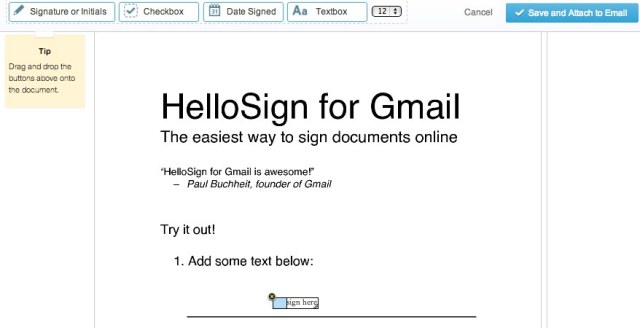
HelloSign, a service of HelloFax, has launched a plugin that lets you fill out and sign documents in Chrome without leaving Gmail.
The HelloSign for Gmail plugin allows a user to open, edit and sign documents in Gmail and automatically loads the signed and edited document as an attachment to be sent. It is now only available in Chrome but will be added as a plugin to Firefox. It is not available in Internet Explorer or the Safari browser.
All signed documents are legally binding and automatically backed up in the user’s HelloSign account with other documents.
Adding the Chrome extension is pretty simple. In its tutorial, HelloSign takes the user through the process. It shows how a contract appears. There are three options for the file: view, download or sign. A signature box appears where you can type your name.
signhere
Here’s another look at the service:
DocuSign is the giant in the electronic signature market. It does not directly provide a way to sign documents and instead integrates with Zapier for people to create the signing app themselves.
I know I would not create my own app to sign documents in Gmail when there is something as easy to use as HelloSign.


The Research Is In: The Virtual Workplace Is Here to Stay, And You Need to Make It Work for You!


It's a New Year, and we at Cresa are always looking for new ways to help tenants cut cost and improve efficiency.  This includes leveraging cutting-edge research to determine what people think about their work environments and what they might expect in the future.  Accordingly, Cresa recently co-sponsored the "World's Largest Workplace Study" through a partnership with HOK, a leading global architectural firm. The survey collected more than 3,600 responses from people in several countries and across multiple industries. It measured demographic data, how employees feel about and function within their workspaces, and included issues such as commute time, number of hours working at home, access to natural light, and illness on
the job.
  
Getting Social
The survey featured a unique approach:  It used Facebook (with over one billion users) as well as LinkedIn to connect with a wide array of workplace employees other than corporate real estate professionals.
  
Spearheading Cresa's involvement in this initiative was Jeff Gagnon, Senior Vice President, Portfolio Strategies, Cresa San Francisco, who works with Cresa clients throughout the country to plan and implement innovative workplace solutions.
  
Survey Highlights
The findings of our survey include the following: 
  • Workers are usually at their desks no more than half the time.
  • Forty percent of office workers believe they can work at home at least three days a week, with the right technology and management support.
  • One-quarter of respondents commute an hour or more to work.
  • The biggest perceived office performance inhibitors are that the workplace is too loud and lacks privacy.
  • Eighty-two percent report some kind of physical ailment at work, especially when they are seated; this begs the need for better ergonomic solutions to protect employees' hands, backs, shoulders, etc.
  • Natural light promotes productivity at work.
Tenant Takeaway
As a tenant, you need to look toward the inevitable changes in the workplace of tomorrow.  You need to evaluate changing workforce dynamics, including cultural realities and how your next generation of workers can be most productive.  You need to cut occupancy costs and improve production.
  
To be sure, the virtual office is here to stay.  But to what extent will it work for you? 
  
There will be challenges in adopting a virtual workplace program, and we will address them in an upcoming email bulletin.  Meanwhile, our advisors and project managers would be pleased to help you evaluate your plans for workplaces today and tomorrow.
  
Hey, it's a New Year.  And there are many more opportunities to plan workplace optimization solutions in the days ahead.
  
For more information on this topic,
click here to read the whole workplace study.  

Friday, January 11, 2013

Communication as Capital; Do We Understand One Another?


“I know what needs to be done. We’re well positioned, nimble, and have the capital and scale to win out. What holds us back?”
It’s a common frustration we hear often from CEOs.
What’s missing?
In our executive search practice, we found that the “precision” of priorities and “quality” of communication are essential differentiators in today’s world of instantaneous information. In a global economy, flexibility is prized, requiring effective communication with precision, speed, clarity, and frequency… all ingredients of successful outcomes.
Yet, we have observed that very few leaders communicate well. The main focus will always be strategy until something, or someone, fails.  And when that happens, the post-mortem generally concludes that communication was the key culprit, i.e., someone didn’t get the memo!
So we decided to learn from leaders who are highly regarded communicators, and asked two questions:
*How do you characterize/describe communication with and among your top team?
*Given that leadership teams are by definition small groups, how do you evaluate the suitability of the individuals you are considering for promotion, or when recruiting for critical roles?
To win out, the best leaders encourage an exchange of views with clarity, conviction, and respect, while placing corporate power politics aside. Simply, it’s about substance, not style. We discovered that a buy-in based on a common set of values and beliefs about “the way things work” is essential.
The glue is a “no other agenda” communication approach.
So, on the first question, we conclude that to maximize the value of teams requires a common set of commitments, as well as common communication style…the way we express the daily journey… to assure that the team stays in sync and on track.
One CEO called it “a memo of understanding of ‘how’ we achieve results and communicate in the process.”
Regarding Promotion and Recruiting, the job description highlighting qualifications is a starter, but not nearly sufficient. In fact, hiring or promoting on it alone is perilous, as “looking good on paper” rarely reflects whether a candidate will succeed in the role. The success of a candidate, once in the role, will be determined by how well they address and work through difficult and unforeseen challenges. Even adding intuition about fit for a “C” level role is not enough.
Referencing, including reaching out to those not provided by a candidate, can assist, but hasn’t proven a reliable predictor of future success, as those references hardly ever know the culture of the hiring company.
And when a hired candidate disappoints it’s usually because of value differential, which results in a failure to culturally integrate, build trust, and communicate effectively within the leadership ranks.
We recognize that all leadership teams are composed of individuals who are asked to contribute their skills and experience to innovate and seek solutions to the most problematic of value-creating challenges. What struck us among the best companies was that great communication is the “how” those leaders work among themselves, and prioritized accordingly.
The Koblentz Group is an executive search firm specializing in recruiting leadership and corporate directors for companies in the multiunit consumer and business service sectors. Over the past 30 years, its Partners have successfully conducted several hundred “C” level recruitments for emerging companies to the Global 100. The firm works worldwide.eprint by Joel Koblentz of the Koblentz Group


Monday, December 31, 2012

Happy 2013


Smart CEOs Work With Human Resources


The relationship with work and human resources is a strained and confusing one. If “Work” and “Human Resources” had Facebook pages the relationship status would be set as “It’s complicated.” Ask the average employee what does HR do? And they will tell you that HR handles the hiring, firing, and garnishments of my wages. We don’t have a very good reputation. Human resources is much more than simply compensation, benefits, and disciplinary actions. A great organization with great leadership and vision understands HR’s true function within the company.

Workplace leaders; managers, supervisor and executives should know that HR is capable of driving organizational success and in order for that to happen, it must come from the top down – I’m talking about the C-SUITE players. The CEO’s, COO’s, CFO’s and CHRO’S have to champion the cause of HR as a strategy partner which helps shape, drive and executes initiatives. These top executives should incorporate the HR team in the company’s plans and communications throughout the organization and the public – external and internal customers.

The first quarter of the year, is usually time for big objectives and forecasting of things to come. The analysts have researched global and market trends and performed metrics to help the C-Suite develop goals. The smart money is on those companies that invite the CHRO, Directors and VP of HR in on the meetings – that’s right the seat at the table- to be an active participant in strategizing and implementing those plans. Since HR manages the human capital or people, which make work happen, it’s only right that HR is involved because HR can provide critical information on job duties, technology, employee productivity and ability.

Let me break it down – You’re the CEO, You want to change the way you make product- you want to be more efficient – lower costs- and reach new markets. Welp, you can’t do any of that without the right employees. Organizational change is difficult on everyone, especially incumbents. No one likes change; it’s something that you learn to accept and for many, acceptance is not in their character. You need to replace those employees; manage them out. You will need to new technology and someone needs to source, screen, recruit, train, compensate and onboard those employees.  You’re going to need to perform job analysis to identify areas of improvement in the workflow process. You’re going to need help spearheading this new direction.

That’s us – that’s HR.

Yeah we can fire people, we can hire people, but it’s not that simple and relegating HR to those functions represents a major flaw in planning your company’s future.

One of my favorite CEO’s is Alan Mulally of FORD Motor Company. I admired the way he brought the company through rough times without accepting government bail-out money. Now Ford makes a better product and is profitable again. Here’s a snippet from an article on Human Resource Executive Online written by Tom Starner:

“With a major change-management scenario required to bring his company out of the cavern of near-financial disaster, Mulally would need to lean heavily on Ford's human resource department. So when Ford began its tough climb back from the darkness in early 2008, Felicia Fields, its newly promoted top HR executive, was included on Mulally's top team.

"One of the first things we did was add Felicia to the Ford leadership team," Mulally says. "During this latest turnaround effort, HR has been there every step of the way. It has played, and will continue to play, a pivotal role in enhancing and executing our mission."
That just about sums it up.

Posted by Chris Fields on 12.24.2012 in Blog

Monday, December 24, 2012

The Termination Discussion – I’d Rather Step On A Lego


There are few things in my world of HR I like less than an investigation into employee unacceptable behavior. It’s one thing when someone steps outside of attendance policy or deliberately violates the code of conduct. It’s another when they have just overstepped common sense too frequently to allow their employment to continue. They become a distraction, a liability, and demand far more energy than they deserve.

I’ve had many of these final discussions. Most were preceded by other discussions about performance issues, inconsistent quality, or general behavior. Truthfully, a large percentage of them are completed without drama. The employee knew this was where things were headed. Each previous conversation was leading to this ultimate meeting where the badge is collected and the employee gets instructions on clearing out their things and how their final check will be delivered.

There will always be those situations that you have to do a little extra preparation for. Just as I used to have to carefully walk through the playroom in our house to avoid those plastic bricks that didn’t find their way back to the box, the discussion has potential to bring great discomfort to the HR leader or team leader guiding this meeting.
So here are some important things to consider.
  • Do you have security lined up? Seriously. There are times that you need to fully consider having someone outside the room in case there is cause for intervention. Depending on your situation, you may even have a uniformed security person there to help assure the employee finds their way off the property.
  • If there is a union involved, you should know what representation is required.
  • Capture everything said, and debrief with any other participants. Was there any sign of revenge? Is there any reason to believe the employee my take some sort of dangerous action toward himself or others? You should have at least one other person in the room who knows what to look for and just keeps their eyes on the employee.
  • Can you manage the meeting away from all other workers so there is not direct visibility? Can you do it off shift?
  • Rehearse. Really. Have answers to possible questions. Not just the questions about benefits and paycheck, but the challenges to your decision. You are not going to debate here, you have a message to deliver.
  • Give yourself some time afterward to document the meeting and get re-focused on the employees that do their job every day. That’s who you just supported.
Finally, remember this: Employees terminate themselves. You just help them close the deal.

a reprint from The HR Introvert

The Termination Discussion – I’d Rather Step On A Lego


R Introvert

Sunday, December 16, 2012

Don't Feel the Squeeze - Be A Leader in Championing Vacation Time

There has been a lot of buzz lately about the US workforce no taking time off for vacation. Compared to other developed countries, we are close to the bottom in the number of days the average worker takes off for vacation. I think Japan is the lowest, shame on them. In a recent poll, the average American worker leaves 9.2 days of unused vacation a year on the table. At the same time profits are close to a 10 year all time high because workers are cramming in more hours. 

If you read all the articles on health and work life balance we should take off the allotted vacation each year to recharge our batteries , reconnect with friends and family. We do not profess that in business however, just the opposite. Your manager or supervisor will say, gee John/Mary we really need you that week because of a critical project or issue, or I cannot spare an additional worker to be out the same time as Mary/Tom. 

I say cut the crap, as HR leaders we should be the champion to encourage taking time off so our workers can be more productive, refreshed, and energized, not unproductive, tired and potentially mistake ridden because they fail to take time off. We need to take the lead on professing time off as well as doing it ourselves, if we truly want to act like leaders. I can honestly say I never did in my 30+ years in HR. I truly gave back vacation to the company every year but one in the last 25 years. How bad is that? The feeling is that the higher up you are the more important you are and therefore feel that you cannot afford to take the time off because of responsibility. Hogwash. if you died tomorrow I am sure the world would continue and you would probably be criticized for not taking more time off and criticized for working yourself to death. I know I felt that criticism from employees and family. 

So, HR, take the lead role in championing vacation time for employees and practice it yourself. Help employees to be strategic about managing their time off.